
10 MÄRKI, ET KANNAD VALES SUURUSES RINNAHOIDJAT
Research has shown that approximately 80% of women wear the wrong size bra. Estonian women with an average bust are often of the opinion that 75B is a universal size that fits them all. In reality, this is of course not the case, but lingerie stores do indeed sell more bras in this particular size than any other. Since a woman's body is in constant flux, undergoing a particularly wonderful transformation during pregnancy and breastfeeding, every woman should always measure her body before buying a new bra. If you forget to do this before heading to the lingerie shop or feel you lack the necessary skills, there is no need to worry; the lingerie experts at BonBon Lingerie salons will always be happy to advise you.
10 signs you are wearing the wrong size bra
1. The bra band is not at the same height in the front and back

The bra band must sit in a straight line both front and back, i.e., horizontally at the same level. This common mistake is easy to identify using a mirror. If the band is higher on your back than in the front, adjust the bra band using the hooks, loosen the shoulder straps, or choose a bra with a smaller band size. When buying a bra, keep in mind that the fasteners should initially be on the widest setting, as the bra will stretch after some wear.
2. Your breasts are spilling over the edges of the cups
The underwire of the bra should sit nicely around your breast; if part of the breast is peeking out from the sides or the top of the cup, the cup is too small, creating the so-called "double breast" effect.
3. The fabric of the bra cup is wrinkled or sagging
You have chosen a bra with a cup that is too big.
4. The bra band is too loose
The bra strap must fit snugly around your body. If you can pull the strap away from your back by more than 5 cm, you are wearing a bra that is too large. Try to tighten the band using the hooks or choose a bra with a smaller size.
5. The bra is chafing your skin
If you have marks on your skin after wearing a bra, the band size was too small. The bra should be snug around your body, but not painful.
6. The shoulder straps hurt
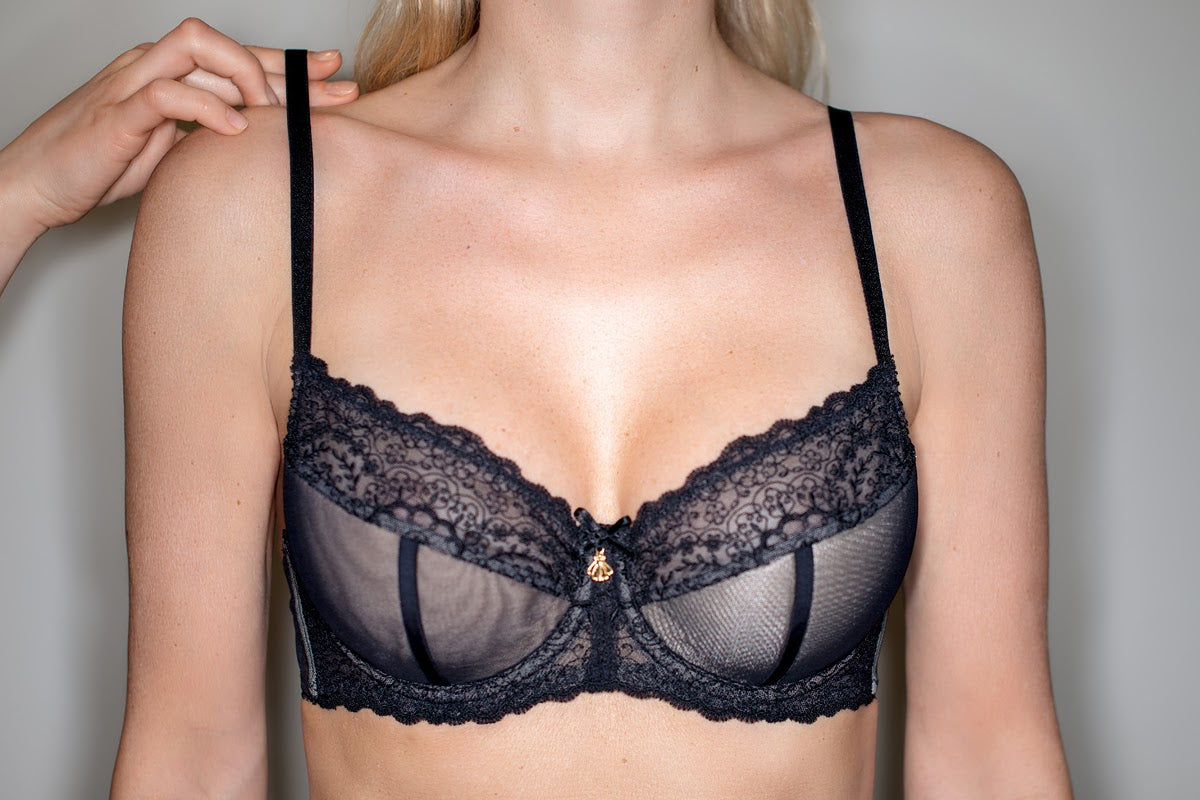
If the shoulder straps hurt, you can try adjusting them, but if that doesn't yield the desired result, the cause may also be a cup or band that is too small. We recommend increasing the cup size first, and if that doesn't help, choose a longer bra band.
7. The bra is pinching your underarm
This is a sign that you need a bra with a larger cup.
8. The bra wire is poking out of the fabric
This happens when you have a bra with a cup that is too small.
9. The center gore of the bra does not sit flat against your chest
If the fabric between your breasts is not against your skin, the cup is too small.
10. You have to adjust your bra throughout the day
A well-fitting bra does not shift during the day, even if you have a very active lifestyle. If you feel the need to adjust your bra throughout the day, you are wearing the wrong size.
Taking measurements
In reality, taking the right measurements for a bra is not difficult at all! You just need to trust the measuring tape and let go of the conviction that you have been the same size your whole life. Once you have found the right size, choosing lingerie from an online store becomes a breeze, not to mention how grateful your partner will be if you give them your bra size as a gift tip before an upcoming anniversary. How to do it:
- Take a measuring tape and measure your circumference under your breasts, i.e., where the bra ends. Ideally, ask someone for help, as you get the most accurate result when your arms are hanging freely and you are relaxed and have exhaled during the measurement. The measuring tape must be in contact with the skin and positioned at the same height front and back. Once you have measured your under-bust circumference, find the range it falls into to determine your bra size number:
- 63-67 cm is size 65
- 68-72 cm is size 70
- 73-77 cm is size 75
- 78-82 cm is size 80
- 83-87 cm is size 85
- 88-92 cm is size 90
- 93-97 cm is size 95
- 98-102 cm is size 100

- Measure your bust circumference at the fullest point of your breasts. The cup size, which is described by the second part of the size (the letter), is determined by the difference in centimeters between your under-bust and bust measurements. Subtract your under-bust measurement from your bust measurement and find your bra cup size accordingly. If the result is:
- 10-12 cm is cup AA
- 12-13 cm is cup A
- 13-15 cm is cup B
- 15-17 cm is cup C
- 18-20 cm is cup D
- 20-22 cm is cup DD
- 23-25 cm is cup E
- 26-28 cm is cup F

Now put the first and second result together, and you have your size!
Did you know that the cup size and band size are related? This means that as the length of the bra band increases, the cup size decreases at the same time, and if the cup size increases, the band becomes shorter.
Bras in different sizes can be equal in volume, meaning that a 70C might fit you just as well as a 75B or 80A. Which one is best also depends on the specific model.
The wrong size can harm your health
Women often tend to choose clothes in the size they wish they were. This approach is intended to motivate weight loss and reaching an ideal weight. Often, however, it only deepens an inferiority complex and a sense of failure. Regardless of other clothing, a bra should always fit well to perform its function: supporting your breasts!
A bra in the wrong size not only looks bad but is also dangerous to your health. A bra that is too small or too large can cause various health issues that you wouldn't necessarily associate with the wrong size underwear at first glance:
1. Reddened skin or pain under the ribcage
The reason for this can be either a bra that is too small or one that has been worn for too long. Generally, the lifespan of a bra depends on the woman's size; more voluminous women should replace their bras every 6-9 months, while very slim women should do so at least every 18 months. In an aged bra, the fabric covering the support wire becomes thin and starts to chafe the delicate skin under the breast, and it also no longer supports the bust as well as it did initially.
2. Pain in the ribs, neck, and back
If the bra does not perform its task and fails to support the breasts, the rest of the body must take the load. Different women hold this weight with different muscles, but the result is the same: muscle tension and pain occur.
3. Sweating and overheating
If the bra strap presses into the skin and the cups are too tight against the skin, the body starts to sweat and overheating may occur. In hot weather, it is worth paying attention to the choice of materials so that the skin can get the necessary cooling.
4. Shortness of breath
Shortness of breath is a particularly big risk for women with active lifestyles. A bra that is too small restricts the mobility of the chest, which makes breathing shallower and shorter. Constantly disturbed oxygen supply eventually affects the entire body.
5. Headaches
Insufficient support from a poorly sized bra forces the upper body muscles to work more intensely. If these muscles are under tension for a long time, the result can be a headache.


